
Secondhand Furniture Pest Check Before Bringing It Inside
On this page
Quick answer
Inspect secondhand furniture outdoors or in a bright staging area before it enters your home. Check seams, screw holes, drawers, undersides, hollow tubing, and packaging for live insects, shed skins, egg cases, spots, webbing, droppings, or gnawing. Photograph uncertain evidence without touching it. Decline heavily infested items and ask a qualified pest professional about ambiguous or widespread signs.
This checklist is for US households evaluating used furniture. A visual check reduces risk but cannot prove that an item is pest-free.

Check before pickup
Ask the seller where the item has been stored, whether the building has had recent pest activity or treatment, and whether the item was exposed to moisture, pets, or curbside conditions. Treat answers as context, not certification. Request clear photos of seams, the underside, the back, and any damage.
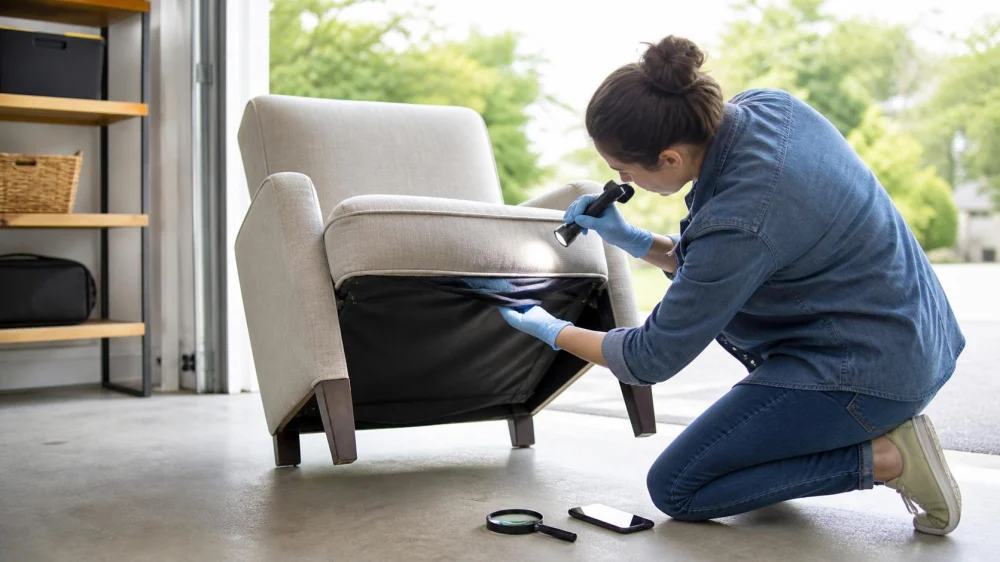
Plan a direct route and a temporary inspection location. A hard, uncluttered floor with strong light makes evidence easier to see and clean. Keep the item out of bedrooms, closets, and carpeted living spaces until the check is complete. Bring a flashlight, magnifier, disposable gloves, white paper, sealable bags for loose hardware, and a phone camera.
Avoid carrying an upholstered item in the passenger area when possible. Protect the vehicle with a removable covering, then inspect and clean the cargo area after unloading. Do not wrap a questionable item so tightly that you hide evidence before inspection.
Triad Pest Control
Winston-SalemForsyth CountyNorth Carolina
1535 S Martin Luther King Jr Dr, Winston-Salem, NC 27107, USA
Inspection checklist
- Start with the exterior. Look for insects, silken webbing, small stains, pellet-like material, gnaw marks, and unexplained holes.
- Follow edges and seams. Shine light along welting, folds, labels, staples, zippers, and the junction of fabric and frame.
- Turn it over safely. Use help for heavy furniture. Inspect feet, dust covers, joints, cracks, and recessed hardware.
- Remove accessible parts. Pull out drawers and cushions and inspect both the piece and the empty cavity.
- Tap over white paper. A gentle tap can reveal loose debris. Do not create airborne dust from material that may be droppings.
- Use the nose cautiously. Strong musty, sweet, urine-like, or chemical odors warrant more investigation, but odor alone cannot identify a pest.
- Photograph findings. Include a coin or ruler nearby for scale without touching the material.
Stop if you find droppings or nesting material. Do not sweep or vacuum suspected rodent waste; CDC cleanup guidance calls for wet disinfection steps because dry cleaning can put contaminated particles into the air.
Check by furniture type
Upholstered furniture: inspect piping, buttons, cushion zippers, folds, the platform beneath cushions, and the underside dust cover. Tears and deep enclosed frames make complete inspection difficult. Mattresses and sleeper sofas have many hiding places and deserve a particularly cautious decision.
Wood furniture: check joints, drawer slides, unfinished backs, screw holes, veneer gaps, and old repair channels. Fine powder and small exit holes can have several causes; preserve a sample or photo and ask a professional before assuming the insect is active.
Metal or plastic furniture: inspect hollow legs, caps, tubing, corrugations, and stacked parts. Smooth surfaces are easier to view, but hidden cavities can still transport insects.
Wicker and woven pieces: examine every overlap and broken strand. Dense weaving offers many narrow spaces and can make reliable inspection impractical.
Keep, isolate, or decline
Keep an item when inspection is complete, surfaces can be cleaned appropriately, and no suspicious evidence appears. Continue monitoring the surrounding area after placement.
Isolate and ask when a valuable item has ambiguous spots, old holes, a detached insect, or inaccessible cavities. Place it only in a location that prevents spread and does not expose people or pets. A pest professional can identify evidence and recommend a treatment suitable for the material.
Decline an item when you see live pests, multiple life stages, extensive droppings, active nesting, widespread damage, or evidence you cannot safely evaluate. The purchase price does not justify bringing an infestation into a home.
What to avoid
- Do not carry a curbside sofa directly into a bedroom.
- Do not rely on a quick spray to penetrate a thick or enclosed item.
- Do not use outdoor-only pesticides indoors or apply any product to furniture unless its label allows that exact use.
- Do not mix pesticides, cleaners, or improvised heat treatments.
- Do not use a household oven, space heater, parked car, or open flame to “heat treat” furniture.
- Do not donate or resell an item with known pest activity.
The EPA emphasizes learning which pest is present, reducing entry and hiding places, and following pesticide labels. A product label—not a social-media recipe—controls where and how a pesticide may be used.
FAQ
Can steam guarantee used furniture is pest-free?
No. Material, depth, temperature, exposure time, and pest species all affect results, and steam can damage finishes or create moisture problems. Seek professional guidance for treatment.
Is solid wood safer than upholstery?
It is generally easier to inspect, but joints, holes, and hollow spaces can conceal pests. No material is automatically pest-free.
Should I use a bug bomb in a garage?
Do not improvise a pesticide treatment. Foggers have label restrictions and may not reach protected hiding places. Identify the pest and use a lawful, targeted plan.
What should I do with a suspicious insect?
Avoid crushing it into the fabric. If safe, contain it in a sealed clear bag or take sharp photos for a pest professional or local extension resource.
How long should I monitor the item?
There is no universal interval for every pest. Ask a professional what signs and time frame apply to the suspected species and item.
Sources and evidence
The EPA's pest-control do's and don'ts supports inspection, exclusion, clutter reduction, and label-following. CDC's rodent cleanup guidance explains why suspected rodent waste should not be swept or vacuumed dry.
Next steps
Choose an outdoor or isolated inspection area, gather a flashlight and camera, and check every seam and cavity before transport into the home. If evidence is active, widespread, or uncertain, keep the item out and obtain identification before deciding whether it can be treated safely.



 K9 Bed Bug Hunter5.0 (7 reviews)
 Defense Pest Control4.0 (56 reviews)
 Vanquish Pest Management, Pittsburgh PA4.0 (34 reviews)
 Minuteman Pest Control Co Inc4.0 (43 reviews)
 All American Termite and Pest Control4.0 (62 reviews)
 Quality Yard and Home Maintenance, LLC.4.0 (275 reviews)
 How to Keep Cockroaches Out of Your Kitchen | PestControlHub
 How to Detect and Control Termites on a Budget: A Practical Guide for Homeowners
 How to Use Biological Control Agents in Home Use
 How to Use Low-Toxic Baits for Rodents: A Safer Way to Control Pests
 How to Clean After Pest Infestations to Prevent Return
 How to Use Barrier Treatments in Basements