How to Discuss Pet and Aquarium Safety Before Pest Treatment
On this page
- Quick answer
- Describe every animal and habitat
- Identify the exact product and label
- Build a pet-specific treatment plan
- Protect aquariums and aquatic animals
- Confirm removal and return instructions
- Keep a treatment record
- Pre-treatment checklist
- Limitations and emergency notes
- Frequently asked questions
- Official sources and evidence notes
- Send one written pet inventory
Quick answer
Before a pest treatment, tell the company about every dog, cat, bird, reptile, amphibian, fish tank, pond, insect colony, small mammal, pet bed, food bowl, and animal medication in or near the work area. Ask for the exact product name, EPA registration number, treatment locations, application method, ventilation steps, and label-based instructions for removing and returning animals. Do not rely on a generic wait time: the registered product label and the planned use determine the precautions.
Get instructions in writing before the appointment so every caregiver follows the same plan.

Describe every animal and habitat
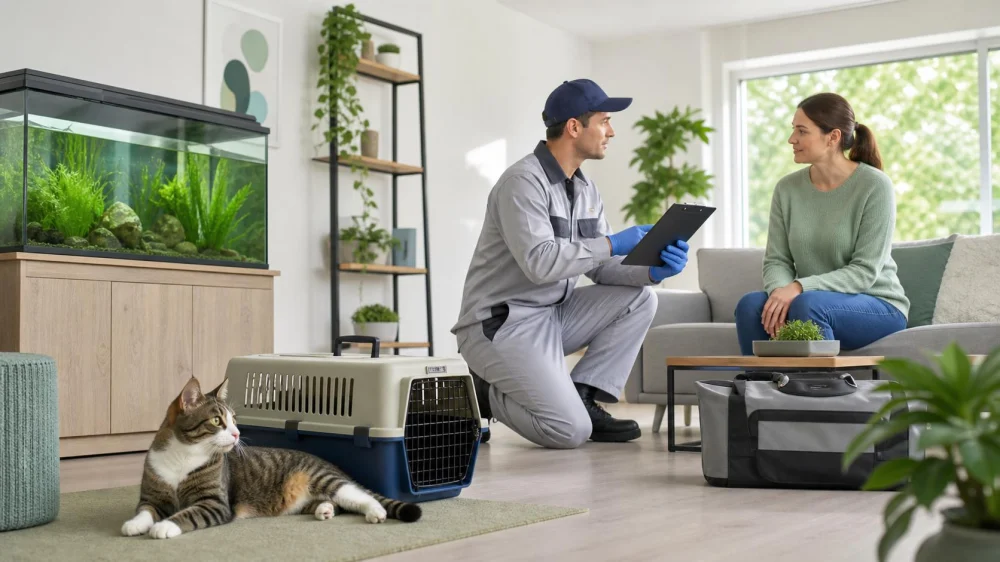
Send the pest professional a room-by-room inventory. Include species, number of animals, enclosure location, whether an enclosure can move safely, and any animal that is very young, old, pregnant, ill, or recovering from treatment. Mention free-roaming birds, reptiles under heat lamps, open-top aquariums, outdoor ponds, and live feeder insects because their exposures differ from those of a crated dog.
Photograph habitat locations for your own planning, but do not share private household images unnecessarily. Ask which rooms, cracks, surfaces, bait placements, yards, or exterior openings will be treated and whether the treatment path crosses feeding or exercise areas.
Identify the exact product and label
Request the product name and EPA registration number before application. Ask whether the technician will use a spray, dust, bait, gel, fogger, granule, trap, or nonchemical control and whether more than one product is planned.
EPA says the pesticide label provides legally enforceable directions for use and safety precautions. Review the current label for statements about pets, birds, fish, food, ventilation, treated surfaces, and reentry. If a diluted product arrives in a service container, EPA recommends identification information that includes the product name, EPA registration number, active ingredient, firm contact information, and relevant precautionary language.
Build a pet-specific treatment plan
Ask the company to distinguish what must be removed, covered, relocated, cleaned, or left untouched. The plan may address animals, bedding, toys, litter boxes, food, water, dishes, grooming supplies, medications, and enclosure accessories. Do not place belongings back until the stated condition is met.
For baits and traps, confirm exact placement and whether a determined pet could reach, chew, or move the device. A “pet-resistant” station is not permission to leave it where an animal can repeatedly investigate it. Ask about physical exclusion, sanitation, and moisture control that could reduce pesticide use.
Protect aquariums and aquatic animals
Fish and aquatic invertebrates may be especially sensitive to some pesticides. Tell the technician about aquariums, sumps, filters, air pumps, planted tanks, amphibian enclosures, and outdoor water features, even if they are in another room.
Ask for product-specific instructions on relocating or covering the system and handling aeration. Do not automatically shut off filtration, heat, or oxygen equipment; doing so can create a separate animal-welfare hazard. Coordinate the treatment plan with an aquatic veterinarian or experienced aquarium professional when safe relocation or equipment management is uncertain.
Confirm removal and return instructions
Write down when animals must leave, how long they must stay away, what “safe to return” means, and who confirms that condition. Some labels require treated surfaces to dry; other applications have different restrictions. Weather, ventilation, surface type, and application method can affect drying, so use the technician's label-based confirmation rather than guessing.
Before animals return, check that spills are addressed, inaccessible baits remain secure, uncovered food and water are replaced as directed, and doors, windows, screens, gates, heat sources, and habitat equipment are restored safely.
Keep a treatment record
Save the service date, company and applicator contact, target pest, product name, EPA registration number, application locations, instructions, and any follow-up visit. Keep the product label or an official link with the record. Note unexpected odor, residue, pet behavior, or exposure without assuming it proves poisoning.
Pre-treatment checklist
- List every animal, enclosure, tank, pond, bowl, and pet item.
- Mark treatment rooms and animal routes.
- Obtain product names and EPA registration numbers.
- Read label directions for the planned use.
- Confirm removal, covering, ventilation, and reentry steps.
- Secure baits and traps beyond pet access.
- Assign one person to verify conditions before return.
- Save the service report and emergency contacts.
Limitations and emergency notes
- This guide cannot determine whether a particular product is safe for a particular animal.
- Never apply or relocate a pesticide contrary to its label.
- Do not induce vomiting or give a home remedy after a suspected exposure unless a veterinarian or poison professional directs it.
- If an animal may have contacted or eaten a pesticide, move it away from ongoing exposure without endangering yourself and contact a veterinarian promptly.
- Keep the product label, registration number, exposure time, and animal's weight available for the call.
Frequently asked questions
Is one standard reentry time safe for every treatment?
No. Follow the exact label and the applicator's written instructions for the product, method, surface, and site.
Should I cover a fish tank or move it?
Ask before treatment. The answer depends on the product label, application area, enclosure, ventilation, and whether relocation can be done without harming the animals.
Can pets stay in an untreated room?
Only if the company confirms that the room, airflow, travel route, and application plan meet label directions and protect the animals.
What if the technician changes products on arrival?
Pause and request the new product name, registration number, label-based precautions, and revised pet plan before application.
Are nonchemical traps automatically pet-safe?
No. Snap traps, glue boards, electrical devices, and enclosed traps can still create access, injury, or stress risks and need appropriate placement.
Official sources and evidence notes
The EPA advises consumers to read the pesticide label first. Its guidance on selecting a pest control service says to follow instructions and keep children and pets out of treated areas until the pesticide spray has dried. Product-specific labels may add precautions such as removing pets and birds or covering aquariums, so the exact registered label controls the plan.
Send one written pet inventory
Before confirming the appointment, send the company your animal and habitat list and ask it to reply with the exact products, treatment map, preparation steps, and return conditions. Put that response where every household caregiver can see it.


 Aptive Pest Control4.0 (6250 reviews)
 Termicide Ltd.5.0 (7 reviews)
 ALCO Animal & Pest Control4.0 (201 reviews)
 Mosquito Joe of Gloucester and Camden County4.0 (558 reviews)
 American Pest4.0 (1394 reviews)
 Abell Pest Control4.0 (161 reviews)
 Why Pests Are More Active After Rain: Understanding the Link Between Weather and Pest Behavior
 How to Keep Flies Out of Your House in the Summer – Effective Tips
 How Pest Biology Affects Control Strategy
 How to Prevent Pest Infestations in Storage Units | Expert Tips
 How to Use Barrier Treatments in Key Zones
 How to Control Pests During Remodeling Projects