
Pest Control Follow-Up: Check Activity and Repairs
On this page
- Review the original service plan
- Track activity without disturbing evidence
- Inspect monitoring devices safely
- Complete sanitation and moisture work
- Verify exclusion and building repairs
- Follow product and reentry instructions
- Prepare useful questions for the technician
- Coordinate pets, children, and residents
- Understand progress and setbacks
- Document the next service step
- Follow-up checklist
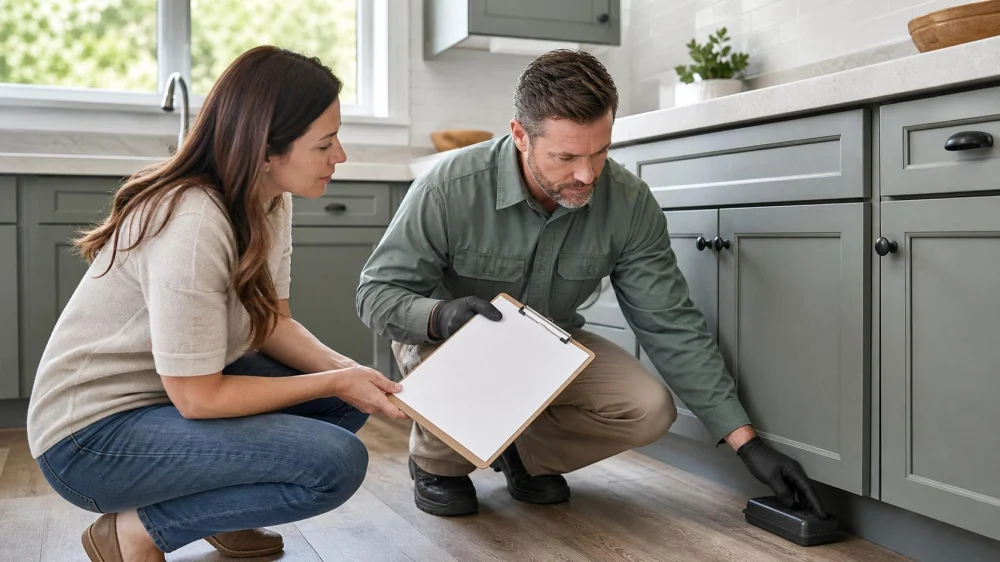
A pest control follow-up visit checks whether the original plan is reducing activity, whether monitors or treatments need adjustment, and whether repairs or housekeeping steps remain unfinished. It is not simply a repeat of the first visit. Good follow-up compares dated evidence with a defined target pest and service scope.
Do not touch traps, baits, dusts, residues, droppings, nests, or unknown insects unless the pest professional and product instructions say it is safe. Keep children and pets away. For stinging insects, rodents, wildlife, suspected venomous species, or a significant infestation, prioritize distance and qualified help.
Before the visit, walk only the accessible areas named in the plan. Do not dismantle cabinets, appliances, walls, or fixtures to search for pests. Note blocked access and let the technician decide how it should be inspected safely.

Review the original service plan
Find the inspection report, target-pest identification, treatment record, product information, preparation instructions, warranty, invoice, and recommended repairs. Confirm which rooms, structures, or exterior zones were included. A follow-up cannot evaluate a vague promise to “treat pests” without naming the organism and objective.
Note the original activity level, locations, dates, and evidence. Ask what result was expected by the follow-up date: fewer sightings, reduced monitor counts, no new damage, sealed entry points, or another measurable change. Different pests and methods require different timelines.

Track activity without disturbing evidence
Keep a simple log with date, time, exact room or exterior area, number seen, behavior, weather, and a ground-level photo when safe. Record whether the pest was alive or dead and whether food, water, light, or a structural gap was nearby.
Do not crush or sweep away every specimen before identification. When instructed, preserve one in a sealed container without direct contact and label the location and date. Avoid collecting wildlife, venomous animals, or contaminated material yourself.
Inspect monitoring devices safely
Observe monitors from a safe distance and note whether they remain in the labeled location, are blocked, damaged, wet, dusty, full, or moved by cleaning. Do not open a bait station, reset a trap, or relocate a device unless the professional specifically authorizes it.
Photograph device placement without revealing private account information or touching the unit. Tell the technician if pets, children, maintenance workers, weather, or furniture movement may have changed access. A missing device needs prompt professional review.
Complete sanitation and moisture work
Follow the written plan for sealed food, cleaned crumbs, covered trash, reduced clutter, repaired leaks, dried surfaces, and managed pet feeding. These steps remove competing food and water and make evidence easier to see. They should be specific rather than an unrealistic demand for a perfectly empty home.
Document plumbing, drainage, condensation, or roof repairs with dates and photos. Replace water-damaged materials only after the source is addressed. Mold, sewage, and contaminated rodent material may require separate qualified remediation and protective procedures.
Verify exclusion and building repairs
Check whether agreed gaps, screens, door sweeps, vents, pipe openings, soffits, and utility penetrations were repaired. Inspect from the ground or an accessible interior area; do not climb ladders or enter unsafe crawlspaces, roofs, or attics.
Ask which openings must remain for ventilation or drainage. Sealing the wrong gap can trap wildlife, block airflow, or damage equipment. The pest professional and appropriate building trade should coordinate when repairs affect wiring, plumbing, roofing, structure, or fire safety.
Follow product and reentry instructions
Keep the service notice and product labels. Follow the stated ventilation, cleaning, reentry, watering, and contact restrictions exactly. Do not scrub treated cracks, apply another pesticide, or add a household fogger because activity persists unless a qualified professional confirms compatibility.
More product is not automatically more effective and can create exposure, repel pests from monitoring areas, or violate the label. If a residue appears accessible to a child or pet, block access and call the service provider for guidance rather than handling it casually.
Prepare useful questions for the technician
Ask whether the identification is still supported, what evidence shows progress, which areas remain active, whether the source is inside or outside, and which next step has the best purpose. Request an explanation of any new product, device, or repair recommendation.
Clarify whether continued sightings are expected, whether they represent newly emerged pests, and what threshold should trigger an earlier call. Avoid demanding a calendar guarantee when biology and building conditions control the timeline; ask for measurable checkpoints instead.
Coordinate pets, children, and residents
Tell the provider about pets, aquariums, children, pregnancy, respiratory sensitivity, allergies, and residents who need help preparing or leaving. Follow professional and label guidance for covering, moving, or protecting items. Never conceal a pet because it seems unlikely to enter the work area.
Notify tenants, caregivers, cleaners, and maintenance staff about restricted rooms and devices without sharing unnecessary personal information. Place reminders where authorized, but do not cover official labels. Confirm who can unlock areas and who will verify reentry.
Understand progress and setbacks
A single sighting does not prove failure, and a quiet day does not prove elimination. Compare trends across the expected lifecycle and monitoring period. Weather, nearby construction, shared walls, sanitation changes, and untreated adjacent units can affect activity.
A setback should prompt renewed identification and source review, not an automatic increase in chemicals. Ask whether the pest is the same species, whether entry points reopened, and whether conditions changed. In multifamily housing, coordinated management may be necessary.
Document the next service step
Request a follow-up report showing findings, devices checked, products applied, repairs observed, resident tasks, next date, warranty status, and early-call threshold. Keep product names and registration details as required in your area.
Confirm who owns each action: resident, landlord, pest company, plumber, roofer, cleaner, or another contractor. Assign dates and preserve photos. An unassigned recommendation is likely to remain unfinished and can undermine the treatment.
Follow-up checklist
Bring the original plan, activity log, photos, device concerns, repair proof, product questions, household changes, and access information. Keep people and animals away from hazards and follow every label and reentry direction.
A useful follow-up turns observations into decisions. It verifies pest identity, measures change, fixes environmental support, and assigns the next action. That process is more reliable than judging success from one sighting or adding uncoordinated products between professional visits.


 Mr. Mosquito4.0 (55 reviews)
 Terra Pest Management Specialists5.0 (44 reviews)
 Pain Exterminating Llc4.0 (517 reviews)
 Firefly Pest Protection Services4.0 (150 reviews)
 Delving Pest Control4.0 (94 reviews)
 Liberty Pest Control4.0 (14 reviews)
 How to Control Rodents Without Poison
 Safe Pest Control Around Food Storage Areas
 Why Pest Education Can Save You Money in the Long Run
 How to Prevent Pest Spread from Yard to House
 How to Prevent Pest Growth in Basements – Effective Solutions and Tips
 How to Make Your Home Less Attractive to Pests – Simple Tips to Protect Your Home