
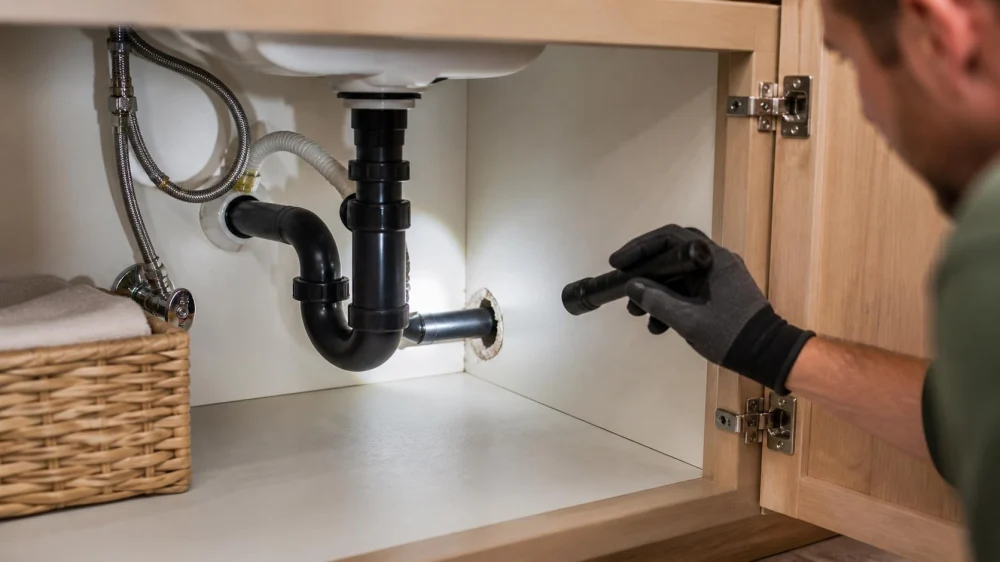
Pest Entry Gaps Under Sinks: Inspect Plumbing Openings Safely
Table of contents
Quick answer
Empty the cabinet carefully, use a flashlight, and inspect where supply lines, drains, wiring, and the cabinet meet the wall or floor. Photograph gaps, moisture, droppings, gnawing, insects, and damaged materials without touching unknown residue. Correct leaks and food access first. Before sealing, identify the pest and make sure you will not trap animals, hide an active leak, or block required access.

Why sink cabinets matter
Plumbing must pass through walls, floors, and cabinet panels. Installers often leave clearance around pipes so parts can be fitted and serviced. Those openings can connect a cabinet to wall voids, crawlspaces, neighboring units, or unfinished utility areas. A warm, dark cabinet with water and stored goods can therefore become both a travel route and a resource area.
A gap is not proof that pests are using it. Ants may follow a countertop edge, cockroaches may hide in a hinge void, and rodents can enter elsewhere before exploring the cabinet. Moisture marks may come from a plumbing leak rather than pest activity. Inspection should collect evidence before a repair is chosen.
Integrated pest management combines identification, prevention, monitoring, and targeted control. Under a sink, that usually means addressing water, food, shelter, and entry—not simply spraying an unknown product into a hole. Treating a visible insect without correcting the route may produce only temporary relief.

Suffolk Organics Tick and Mosquito Control
ShorehamSuffolk CountyNew York
21 Jomar Rd, Shoreham, NY 11786, USA
Inspect without disturbing
Keep children and pets away while you inspect. Put on appropriate disposable gloves and use a bright flashlight. Remove one item at a time and check it before placing it in a clean temporary bin. Do not shake bags or boxes indoors if you see insects, webbing, droppings, or gnaw marks.
Look at:
- Openings around hot and cold supply pipes
- The drain connection and rear cabinet panel
- Cabinet corners, toe kicks, and floor seams
- Pipe condensation and active drips
- Swollen particleboard, staining, or mold-like growth
- Droppings, shed skins, egg cases, webbing, or dead insects
- Gnawing on wood, plastic, hoses, or stored goods
- Loose trim, damaged caulk, and holes for wiring
Take wide and close photographs with a ruler or coin nearby for scale without placing it in contaminated material. Record the date, time, and whether signs are fresh or old. Avoid sweeping or vacuuming rodent droppings; public-health guidance calls for specific wet disinfection methods because dry disturbance can create exposure.
Do not put a hand into a dark opening. Sharp metal, live wiring, hot pipes, insects, rodents, and contaminated debris may be inside. If you hear an animal, see a large nest, smell gas, find damaged wiring, or encounter extensive waste, stop and contact the appropriate licensed professional or property manager.
Fix moisture and food
Check for active leaks by drying the cabinet floor and observing the supply valves, hoses, trap, disposal, dishwasher connection, and pipe joints while water runs. Do not tighten or dismantle plumbing beyond your competence. A small recurring drip can damage cabinetry and maintain a water source for pests; arrange repair promptly.
Condensation may form on cold pipes in humid conditions. A plumber or building professional can determine whether insulation, ventilation, or another correction is appropriate. Do not cover a pipe or valve in a way that conceals leaks or interferes with service.
Move food, pet food, and loosely wrapped items out of the cabinet. Clean ordinary spills with the product and method suitable for the cabinet material. Store sponges and cloths so they can dry, empty trash regularly, and keep recycling free of residue. Avoid creating piles of bags that provide shelter and hide evidence.
If pesticides, cleaners, or other household chemicals are stored there, keep them in original labeled containers and follow all label storage directions. A leak-prone cabinet may be an unsuitable location. Never transfer pesticide into a food or beverage container.
Plan exclusion
Identify the purpose and depth of each opening before sealing. A shallow gap through the decorative cabinet back is different from a pathway through a fire-rated wall, shared plumbing chase, or floor. Multifamily buildings may have fire, plumbing, pest-control, and maintenance rules that require approved materials and authorized work.
Small nonstructural finish gaps may be suitable for an appropriate sealant, while larger openings can require backing material, metal, or professional repair. The correct material depends on gap size, moisture, heat, movement, pest type, building code, and access needs. Expanding foam alone is not a universal rodent barrier and can make future plumbing work harder.
Do not seal an opening while an animal may be inside. Exclusion at the wrong time can trap wildlife, separate young from adults, or drive pests into another room. Active rodent, wildlife, termite, or substantial cockroach evidence deserves species-specific professional planning.
Tenants should document conditions and notify the property manager according to the lease and local process before altering shared building components. Owners should coordinate plumbing repair and pest exclusion so one trade does not undo the other's work.
Monitor the result
After cleanup and repair, create a baseline photograph. Check the cabinet regularly for new moisture, debris, droppings, or insects. Date observations and note whether activity decreases. A monitoring device recommended for the identified pest can help, but it must be placed and used according to instructions and kept away from children and pets.
If activity continues, reconsider the identification and inspect connected areas rather than repeatedly adding products. Adjacent cabinets, wall penetrations, appliance voids, and shared utility chases may be involved. A pest professional can use the evidence log to focus inspection.
When a pesticide is proposed, ask for the product name, target pest, application location, preparation steps, reentry directions, and post-treatment instructions. The label governs legal use and safety directions. More product is not better, and mixing products can be dangerous.
Limitations
This article cannot identify a pest, approve a building repair, or replace a plumber, electrician, property manager, public-health official, or licensed pest professional. Building construction and pest behavior vary. Unknown droppings, nests, biting or stinging pests, damaged wiring, gas odors, and major leaks require specialized help.
Pesticide laws, licenses, tenancy duties, and building codes vary by location. Always follow the complete product label and local requirements. Do not apply a pesticide to a site or pest not listed on its label.
Sources and evidence
The US Environmental Protection Agency describes integrated pest management as a common-sense approach that emphasizes prevention, monitoring, and the least hazardous effective combination of methods. EPA resident guidance recommends denying pests food, water, and shelter, sealing entryways, and following pesticide labels.
Frequently asked questions
Should I seal every pipe gap immediately?
No. First identify the opening, pest evidence, leak risk, access needs, and building requirements. Active animals or shared utility penetrations may require professional work.
Can I spray pesticide into a wall opening?
Do not apply a product unless its label permits that pest, site, and method. Blind application can create exposure and may not reach the source.
What if I find rodent droppings?
Keep people and pets away and do not sweep or vacuum them. Follow current public-health cleanup guidance or hire trained help, especially for extensive contamination.
Does caulk stop cockroaches?
Sealing small routes can support control, but food, water, hidden harborages, and connected units may still sustain activity. Use exclusion as part of a broader IPM plan.
Who should repair a rental-unit gap?
Document it and notify the property manager through the required process. Responsibility and approved methods depend on the lease, building rules, and local law.
How often should I recheck?
Check soon after repairs and then periodically, especially after plumbing work or renewed activity. Compare dated photographs rather than relying on memory.
Conclusion
Under-sink gaps deserve a methodical inspection, not an automatic spray or patch. Document the opening, correct leaks and food access, identify the pest, and choose an exclusion repair that preserves safety and service access. Monitor afterward. When evidence is extensive or the building system is shared, coordinate qualified plumbing, maintenance, and pest-control help.



 Kuma Pest Control4.0 (299 reviews)
 All American Termite & Pest Control3.0 (27 reviews)
 Full Force Pest Control5.0 (29 reviews)
 Ehrlich Pest Control4.0 (634 reviews)
 Mosquito Tech5.0 (73 reviews)
 Wilson's Exterminating Service5.0 (24 reviews)
 How to Discuss Pet and Aquarium Safety Before Pest Treatment
 How to Monitor Pest Return After Rainy Seasons
 Wasp Nest Removal: What Homeowners Need to Know
 How to Use Bait Stations Safely Around Children
 How to Effectively Deal With Pest Infestations in Subgrades | PestControlHub
 How to Control Termites in Hard-to-Reach Areas Effectively