
Termite Swarm Indoors: What Shed Wings Mean and What to Do Next
On this page
Quick answer
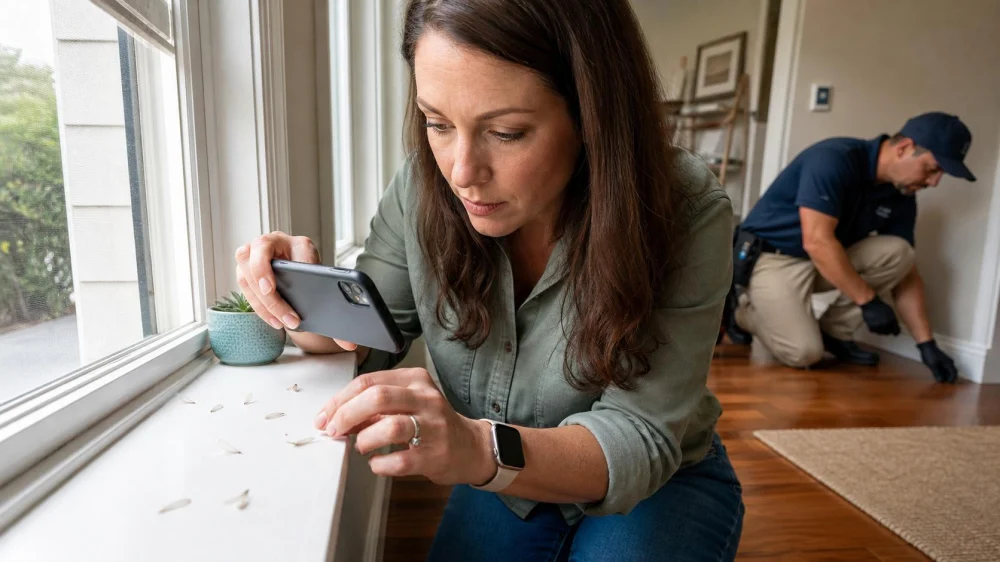
A cluster of small winged insects or piles of nearly identical shed wings inside a home can be a termite warning, especially near a window, door, light, baseboard, or wall opening. Photograph the insects and exact location, save a few intact specimens in a sealed container, clean up the remainder, and arrange an inspection with a properly licensed termite professional. Do not assume that killing the visible swarmers eliminates a colony.
Flying ants are often mistaken for termites, so identification matters before treatment. An indoor swarm does not tell you by itself how extensive an infestation is or which control method fits the building. Preserve the evidence and avoid drilling, opening walls, or applying an unlabeled pesticide while you wait for an assessment.

Save useful evidence
Take close, well-lit photos before vacuuming. Include one photo that shows the whole window, wall, or room and another that shows an insect beside a coin or ruler for scale. Record the date, time, weather, approximate number seen, whether they were flying or already wingless, and how long activity lasted. Note whether the event followed rain or a warm weather change without treating that timing as proof of species.
Place several intact insects and loose wings in a small sealed vial or zipper bag. Do not handle an unknown pesticide-treated insect with bare hands. Label the sample with its location. If you vacuum the rest, empty the vacuum into a sealed trash bag outside the living area according to the appliance instructions; cleaning removes the nuisance but does not treat a hidden colony.

Compare termites and flying ants
Termite swarmers generally have two pairs of wings that are roughly equal in length, a broad waist, and relatively straight antennae. Winged ants typically have longer front wings than hind wings, a pinched waist, and elbowed antennae. These are useful screening clues, not a substitute for identification under good lighting by someone trained to distinguish local species.
The U.S. Environmental Protection Agency’s guide to identifying and controlling termites notes that many people first recognize a problem after seeing a swarm or finding damage during construction. Ask the inspector to show you the features used for identification and to explain whether the evidence points to subterranean, drywood, or another termite group relevant to your area.
Map where the swarm appeared
Mark each observation on a simple floor plan. Look without dismantling for shed wings, live or dead insects, narrow mud-like tubes, blistered paint, stained trim, soft or hollow-sounding exposed wood, and moisture near plumbing or exterior walls. Photograph anything suspicious before touching it. Never probe wiring areas, gas lines, structural members, finished wall cavities, or a place that requires a ladder you cannot use safely.
A windowsill can be a collection point because winged insects move toward light; it is not necessarily the colony entrance. Tell the inspector about crawl spaces, slab additions, porches, decks, attached garages, prior water damage, old treatment holes, wood-to-soil contact, and past termite service. Provide previous reports and warranties when available.
Avoid common response mistakes
Do not rely on a general indoor bug spray to protect the structure. A spot spray may kill visible insects, scatter activity, contaminate evidence, or expose people and pets without reaching the source. Never use a product unless the pest and application site appear on the EPA-registered label, and follow every direction, ventilation rule, protective measure, and reentry interval exactly.
Avoid pouring chemicals, fuel, bleach, or household mixtures into walls or soil. Do not seal every suspected opening before inspection, remove mud tubes, tear out wood, or discard damaged material that could help locate activity. Postpone cosmetic repair until the termite problem and any moisture or structural damage have been assessed.
Check moisture and wood conditions
From accessible areas, look for leaking faucets, supply lines, drains, roof edges, air-conditioning condensate, clogged gutters, poor downspout discharge, and soil that stays wet beside the foundation. Note the problem and arrange the appropriate plumbing, roofing, drainage, or building repair. Do not enter a wet crawl space, disturb mold, or approach exposed electrical components.
Keep firewood, lumber, cardboard, stumps, and other cellulose material away from the foundation and off the ground where practical. Maintain visible clearance between soil and wood siding or framing. Trim vegetation that blocks inspection access or traps moisture, while protecting utilities and following local landscaping requirements.
Arrange a professional inspection
Contact more than one termite company when time and conditions allow. Verify the company and applicator through your state pesticide regulatory or licensing agency. Ask whether the inspection covers the interior, exterior, foundation, crawl space, attic or roof framing when relevant, attached structures, and accessible moisture sources. Clarify whether the inspection has a fee and whether you will receive a written diagram and findings.
Show the sample, photos, map, and previous records. A useful report should separate observed active termites from old damage, conducive conditions, and inaccessible areas. Ask what evidence supports the identification, what additional access is needed, and whether a contractor or structural professional should evaluate damaged wood. A pest technician controls pests; structural repair may require a different license and expertise.
Understand treatment options
Options vary with termite type, construction, infestation location, soil, water sources, local rules, and label requirements. EPA describes registered approaches that can include liquid soil-applied termiticides, bait systems, treated building materials, and wood treatments. Some work requires trained professionals and specialized equipment; fumigation, where appropriate, is not a do-it-yourself task.
Ask how the proposed method reaches the identified problem, what preparation is required, how people, pets, aquariums, food, wells, and sensitive landscaping will be protected, and when occupants may reenter. Request the product name, EPA registration number, label, Safety Data Sheet when applicable, application locations, and written post-treatment instructions before service.
Compare termite proposals
Compare scope, evidence, treatment method, total price, follow-up schedule, monitoring, repair exclusions, and warranty terms—not only the initial cost. Determine whether the agreement covers retreatment, damage repair, or both; what inspections are required to keep coverage; whether there are annual renewal fees; and what happens if the property is sold.
Be cautious with pressure to sign immediately, vague claims of a “safe” or “non-toxic” treatment, guaranteed identification without inspection, or a bid that omits application areas and product details. Confirm that the company carries required insurance and that the person performing restricted or regulated work has the correct credential. Keep the contract, diagram, label, application record, receipts, and future inspection reports together.
Reduce future termite pressure
- Repair plumbing, roof, and drainage leaks promptly.
- Direct gutters and downspouts away from the foundation as appropriate.
- Keep foundation vents open and unobstructed where the building design requires them.
- Reduce cracks and utility penetrations using materials suitable for the structure.
- Avoid soil or mulch covering wood siding, framing, or inspection gaps.
- Store firewood and scrap wood away from the house and above soil.
- Schedule periodic inspections based on local risk and contract terms.
Prevention reduces favorable conditions but cannot prove a property is termite-free. If swarmers return, new mud tubes appear, wood changes, or the treatment warranty requires monitoring, contact the provider and document the new evidence. For suspected pesticide exposure, move away from the source, follow the label’s first-aid directions, and contact Poison Control at 1-800-222-1222 in the United States; call emergency services for severe symptoms.





 Monster Trapping and Pest5.0 (20 reviews)
 Parks Pest and Termite5.0 (8 reviews)
 Tactical Pest and Termite Solutions5.0 (17 reviews)
 RedCheck Pest Solutions LLC5.0 (72 reviews)
 Nature Boy Pest Control LLC5.0 (230 reviews)
 Torpedo Mosquito + Gnat of Atlanta5.0 (15 reviews)
 How to Choose Pest Control Frequency
 How to Use Remote Monitoring Devices for Insects
 How to Prevent Pest Intrusions at Door Frames: Essential Tips for Homeowners
 How to Keep Wasps Away From Garage Openings
 How to Use Low-Toxic Sprays Safely: A Comprehensive Guide for Homeowners
 How to Evaluate Pest Control Technologies Effectively