
Tick Found Indoors: Check People, Pets, and Clothing
On this page
- Quick answer
- Determine whether the tick is attached
- Remove an attached tick correctly
- Avoid heat and home substances
- Check for additional ticks
- Contain and dispose safely
- Record and monitor the bite
- Look for the likely source
- Indoor tick checklist
- Frequently asked questions
- Sources and evidence notes
- Conclusion and next steps
Quick answer
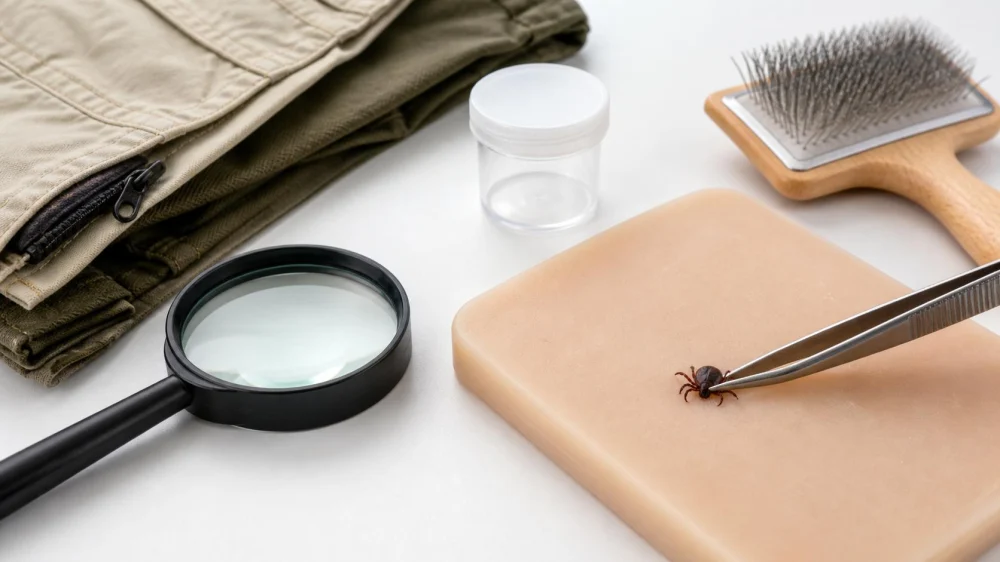
If a tick is attached to a person, remove it immediately with clean fine-tipped tweezers: grasp as close to the skin as possible and pull away with steady, even pressure without twisting or jerking. Clean the bite area and hands afterward. Do not use petroleum jelly, nail polish, heat, or another substance to make the tick release.
Check the person’s entire body, clothing, gear, household members, and pets for more ticks. Contact a veterinarian for a tick attached to an animal. Keep children and bare hands away from loose ticks, and dispose by sealing in a container, wrapping tightly in tape, flushing, or placing in alcohol as CDC directs.

Ehrlich Pest Control
MechanicsburgCumberland CountyPennsylvania
5060 Ritter Rd, Mechanicsburg, PA 17055, USA
Determine whether the tick is attached
A loose tick may crawl on a wall, floor, garment, pet bed, or furniture. An attached tick has its mouthparts anchored in skin and may be small and flat or enlarged after feeding. Do not squeeze the body to test attachment.
Use bright light and, if available, magnification. If the spot cannot be distinguished from a mole, scab, skin tag, splinter, or another object, do not dig at it. Ask a healthcare professional. For an animal, contact a veterinarian rather than applying human medical guidance.

Remove an attached tick correctly
- Use clean fine-tipped tweezers.
- Grasp the tick close to the skin surface, avoiding pressure on its body.
- Pull away from the skin with steady, even pressure.
- Do not twist, jerk, crush, or repeatedly reposition.
- If mouthparts remain and cannot be removed easily with tweezers, leave them alone and let the skin heal.
- Clean the bite area and hands with soap and water, rubbing alcohol, or hand sanitizer.
CDC advises removing an attached tick as soon as possible rather than waiting for a healthcare appointment. Seek help when removal cannot be done safely or the location is difficult, such as near the eye.
Avoid heat and home substances
Do not apply petroleum jelly, nail polish, essential oil, gasoline, glue, or a hot match. CDC warns that substances or heat used to force detachment may agitate the tick and cause infected fluid to enter the skin. Do not cut, burn, puncture, or crush the tick with fingers.
Do not take leftover antibiotics or use a pesticide on human skin unless it is specifically labeled for that use and applied as directed. CDC does not generally recommend antibiotics after every tick bite, though a clinician may consider preventive treatment in defined circumstances.
Check for additional ticks
Examine the scalp and hairline, ears, underarms, waist, groin, backs of knees, between legs, around socks, and other skin folds. Check children with an adult’s help. Showering can help with unattached ticks but does not replace careful inspection.
Inspect clothing, shoes, backpacks, blankets, sports equipment, and outdoor gear. Follow CDC laundry and tick-prevention guidance for handling clothing after exposure. Check pets daily in areas such as ears, eyelids, collar, front legs, between toes, hind legs, and tail, and use only veterinarian-recommended prevention for the correct species and weight.
Contain and dispose safely
CDC lists several options: place the live tick in a sealed container, wrap it tightly in tape, flush it down the toilet, or put it in alcohol. Do not crush it with fingers. If a clinician or local program requests the specimen, label a sealed container with the date and likely exposure location.
Routine commercial tick testing is not a substitute for medical evaluation, and results may not predict whether disease was transmitted. Follow clinician and local health-department advice about identification or testing.
Record and monitor the bite
Record the date, body location, likely exposure place, travel, tick appearance, and removal method. A clear photo beside a ruler can help document size without delaying removal. Watch for rash, fever, fatigue, headache, muscle pain, or joint swelling and pain during the following days and weeks.
CDC advises seeing a healthcare professional if rash or fever develops and sharing when and where the bite occurred. Seek urgent care for severe headache, breathing difficulty, facial weakness, confusion, rapidly worsening illness, or another emergency symptom. Do not wait for a classic bull’s-eye rash; tickborne illnesses have varied presentations.
Look for the likely source
One indoor tick often arrives on a person, pet, clothing, or gear after outdoor exposure. Review recent hiking, yard work, tall grass, brush, leaf litter, travel, and animal activity. Vacuum the immediate area and launder or manage exposed items using appropriate guidance.
Repeated indoor ticks, multiple life stages, or ticks around pet-resting areas justify professional identification and inspection. A pest professional can assess species, entry route, host activity, and targeted control. Avoid broadcast pesticide use without confirming the pest and label site.
Indoor tick checklist
- Decide whether the tick is loose or attached.
- Remove an attached human tick immediately with tweezers.
- Grasp near skin and pull with steady even pressure.
- Never use heat, polish, petroleum jelly, or essential oils.
- Clean skin and hands after removal.
- Check the whole body, clothing, gear, family, and pets.
- Dispose in a sealed container, tape, toilet, or alcohol.
- Record date, body site, and likely exposure place.
- Watch for rash, fever, and other symptoms.
- Seek professional inspection for repeated indoor findings.
Frequently asked questions
Should I wait for a doctor to remove an attached tick?
CDC says remove it as soon as possible; delaying may increase disease risk.
Should I twist the tweezers?
No. Pull away from the skin with steady, even pressure.
What if mouthparts remain?
Remove them only if they come out easily with tweezers; otherwise leave them and let skin heal.
Can I crush a tick with my fingers?
No. Use one of CDC’s contained disposal methods.
Should every bite get antibiotics?
No. A healthcare professional decides whether specific circumstances support preventive treatment.
Does one tick mean an indoor infestation?
Not necessarily. It may have been carried inside, but repeated findings need identification and inspection.
Sources and evidence notes
The U.S. Centers for Disease Control and Prevention’s What to Do After a Tick Bite supports prompt removal, a close-to-skin grip, steady pressure, safe disposal, cleaning, a second tick check, and medical attention for rash or fever. CDC’s tick-removal fact sheet warns against petroleum jelly, heat, nail polish, and similar detachment methods.
Tick species and disease risk vary by geography and exposure. A healthcare professional, veterinarian, pest professional, or local health department should address the relevant person, animal, property, or public-health question.
Conclusion and next steps
When a tick appears indoors, first determine whether it is attached. Remove an attached human tick promptly and correctly, check for more, contain disposal, and document the exposure. Monitor health and ask the appropriate medical, veterinary, or pest professional for help instead of using heat, chemicals, or broad pesticide treatment.





 FSS, Inc.4.0 (4 reviews)
 Red Rodent Remover0.0 (0 reviews)
 A-1 Pest Control5.0 (1019 reviews)
 Lawn Doctor of Kingston, Poughkeepsie & Hudson4.0 (131 reviews)
 H & M Exterminators5.0 (4 reviews)
 Elite Wildlife Control4.0 (50 reviews)
 How to Block Pest Entry Points Around Windows
 How to Effectively Deal With Pest Infestations in Subgrades | PestControlHub
 How to Use Preventative Treatments in Basements: A Comprehensive Guide
 How to Evaluate Pest Control Guarantees | PestControlHub
 How to Use Smart Sensors for Insect Detection: A Modern Approach
 How Often Should You Schedule Pest Control Services?