
Why Bugs Gather Around Porch Lights and What to Change
In this guide
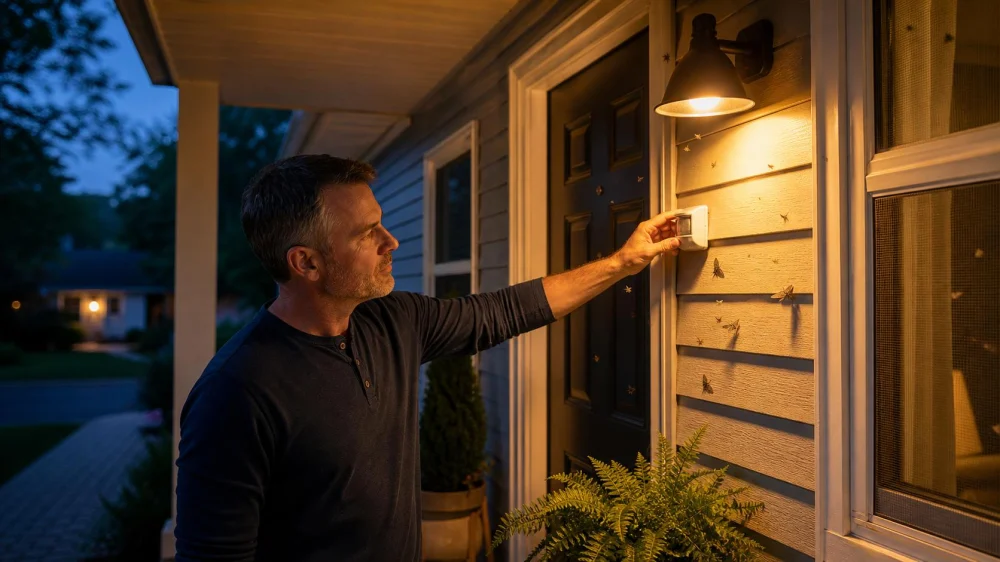
A porch light can become the brightest landmark in a dark yard. Moths, small flies, beetles, and other night-active insects may circle the fixture, rest on nearby walls, or slip indoors when the door opens. The crowd can be annoying, but it does not automatically mean the house is infested. Often the most effective response is to adjust when, where, and how the area is illuminated, then block the nearby routes insects use to enter.
Arrow Services, Inc. (Pest Control)
4122 N Wells St, Fort Wayne, IN 46808, USA
Quick answer
Reduce insects around a porch by turning off lights that are not needed, using timers or motion controls, directing light downward, and moving bright fixtures away from doors and windows when practical. Warmer or yellow-toned lamps may attract fewer night-flying insects than some broad-spectrum or ultraviolet-rich lights, but they do not repel bugs. Repair screens, weatherstripping, and gaps so insects drawn near the building cannot enter. Also investigate moisture, garbage, drains, standing water, and plant material if large numbers persist.

Why some insects move toward light
Scientists use the term positive phototaxis for movement toward light, but insect behavior around artificial lighting is more complicated than a single instinct. Different species may use natural light for orientation, confuse a nearby lamp with a distant celestial reference, respond to particular wavelengths, or become trapped in repeated flight near a bright source. Heat, shelter, prey, and nearby habitat can contribute too.
The result is familiar: insects orbit a bulb, collide with a fixture, settle on a lit wall, or accumulate beneath an overhang. Predators such as spiders may then build webs where prey is abundant. Turning on a porch light does not create insects; it redistributes some that were already active nearby and makes them more visible.
Not every insect responds the same way
“Bugs around the light” may include moths, caddisflies, midges, flies, beetles, leafhoppers, lacewings, or true bugs. Some are harmless visitors, some are beneficial, and a few can bite or become indoor nuisance pests. Species, season, weather, nearby water, vegetation, and regional migrations all change what appears.
Lighting is not a reliable mosquito-control strategy. Colorado State University Extension notes that ultraviolet bug zappers do not reduce outdoor mosquito biting rates and kill many harmless or beneficial insects. Yellow “bug” lights may be less attractive to some insects, but they do not repel mosquitoes. For a biting-insect problem, identify the insect and address its biology rather than assuming every flyer at the lamp is the cause.
Use less light where possible
The simplest intervention is often the strongest: remove illumination that serves no current purpose. Turn decorative and entry lights off after visitors arrive, or use a timer that follows household routines. Motion sensors can provide light for access while avoiding hours of continuous attraction. Adjust sensitivity and duration so pets, vegetation, and street movement do not keep triggering the fixture.
Preserve light needed for stairs, addresses, cameras, accessibility, and personal security. The goal is not complete darkness at the expense of safety. Use the lowest level that provides adequate visibility and meet local building, rental, community, and dark-sky requirements. Neighbors may also be affected by glare, so a well-controlled fixture can solve several problems at once.
Change fixture placement and direction
A bright lamp directly beside a frequently opened door concentrates insects at the exact place where they can enter. If wiring and design allow, place the primary light a short distance away so it illuminates the walkway without making the doorway the brightest point. A licensed electrician should handle wiring changes and fixtures must be rated for the location.
Use shielded fixtures that direct light down onto the step or path instead of sideways into the yard or upward into the sky. Replace clear exposed bulbs with enclosed or well-shielded designs compatible with the fixture. Keep lights from shining directly through windows, where insects may gather outside and indoor lights may draw them toward the glass.
Solar path lights can distribute lower-level illumination, but quality and brightness vary. Do not create a new line of unnecessary light through habitat simply to move insects away from one fixture. Start with fewer, better-aimed sources.
Choose light color thoughtfully
Many night-flying insects are more responsive to shorter wavelengths, including ultraviolet and blue-rich light. Warmer, amber, or yellow-toned lamps that emit less of those wavelengths can reduce attraction for some species. This is a tendency, not a guarantee. Brightness, fixture design, duration, location, and the local insect community also matter.
Look for a warm appearance and appropriate brightness rather than trusting marketing terms alone. A yellow bulb is not a chemical repellent and will not create an insect-free zone. Colorado State University advises that lights lacking certain attractive wavelengths may be less appealing but have no repellent effect. Try one change at a time for several evenings so you can tell whether it improves the situation.
Confirm that replacement lamps match the fixture's socket, enclosure rating, wattage limits, dimmer or sensor compatibility, and wet- or damp-location requirements. Turn power off and allow bulbs to cool before replacement.
Strengthen doors, screens, and seals
Light management reduces gathering, while exclusion prevents entry. At dusk, stand inside with interior lights low and inspect the closed door for visible gaps. Check the sweep, threshold, weatherstripping, corners, and the meeting point between double doors. Repair torn window and vent screens and make sure screen doors close fully.
Seal appropriate cracks around frames, penetrations, soffits, and utility openings with materials suited to the location. Do not block drainage paths, combustion-air openings, required ventilation, or emergency egress. Larger building-envelope problems, high work, and electrical penetrations belong with qualified professionals.
Habits help too. Close the door promptly instead of holding it open under a lit fixture. Turn off the porch light briefly before bringing in groceries if another safe light source provides visibility. Avoid placing an illuminated indoor lamp directly beside an open unscreened window.
Check moisture and breeding sources
If insects remain numerous after lighting changes, the lamp may only be revealing a nearby source. Inspect for standing water in containers, clogged gutters, leaking spigots, wet organic debris, uncovered garbage, pet waste, overripe fruit, or poorly maintained drains. Different insects breed in different materials, so identification matters.
Moth flies, for example, can develop in the biological film inside persistently wet drains, while fungus gnats may develop in damp potting media. Flying termites or ants may appear in seasonal swarms and require accurate identification. A nearby pond or stream can produce harmless aquatic insects that emerge in large numbers for a brief period. Eliminating every outdoor insect is neither realistic nor ecologically desirable.
Move dense vegetation away from direct contact with doors and windows where practical, but do not remove habitat indiscriminately. Trim for access and airflow, correct moisture problems, and preserve beneficial planting with an integrated approach.
Clean fixtures safely
Dead insects, webs, and debris can make a fixture look worse and may attract scavengers. Switch the light off at the appropriate control or breaker and let it cool before cleaning. Follow the manufacturer's instructions for opening covers and replacing lamps. Use a dry brush, vacuum attachment, or damp cloth as appropriate; never spray cleaner into an energized fixture.
Wear gloves when handling accumulations and avoid breathing dust. If the fixture contains broken glass, exposed wiring, water, corrosion, heat damage, or a wasp nest, stop and seek appropriate help. Work from stable ground whenever possible. Ladder and electrical hazards are more serious than the nuisance insects.
Understand bug-zapper limits
Electric bug zappers can kill insects attracted to their light, but a visible catch does not prove they reduce the pest of concern. Research summarized by Colorado State University Extension indicates that ultraviolet-only zappers are ineffective at reducing mosquito biting outdoors and kill many non-target insects. Some devices can also scatter insect fragments, making them unsuitable near places where food is prepared or eaten.
A trap should be selected for an identified pest and placed according to validated guidance. Randomly adding a brighter ultraviolet source can draw more insects into the area. Avoid combining traps with unneeded pesticide applications. If biting, stinging, or indoor activity continues, a licensed pest professional or local cooperative extension service can help identify the source and evaluate options.
A practical evening-lighting plan
- Observe first. Note the time, weather, fixture, and type of insect for several evenings.
- Remove unnecessary hours. Turn off decorative lighting and shorten timers.
- Lower and aim illumination. Use the least brightness that safely covers the path.
- Try a warmer lamp. Choose a compatible, outdoor-rated option and compare results.
- Seal the nearby entry. Repair sweeps, weatherstripping, and screens.
- Inspect environmental sources. Correct standing water, leaks, garbage, and wet debris.
- Identify persistent activity. Photograph or safely collect a specimen before treatment decisions.
Change one major variable at a time when possible. If the light, fixture, timing, and landscaping all change in one evening, it will be difficult to learn which action mattered.
Frequently asked questions
Do LED bulbs attract fewer bugs?
It depends on the LED's spectrum, brightness, and design. Some warm LEDs emit less ultraviolet and blue-rich light than other lamps and may attract fewer insects, but “LED” alone is not a guarantee.
Will a yellow bulb keep mosquitoes away?
No. A yellow-toned light may be less attractive to some insects, but it is not a mosquito repellent. Use evidence-based mosquito prevention aimed at breeding water, screening, protective clothing, and registered repellents used as directed.
Why are there spiders near my porch light?
Spiders may build webs where flying prey gathers. Reducing unnecessary lighting and cleaning abandoned webs can make the site less productive, but spiders are also beneficial predators and most outdoor activity does not require pesticide treatment.
Why did bugs suddenly appear for only a few nights?
Seasonal emergence, migration, rain, temperature, and wind can create short-lived peaks. Document the insects and wait for identification before assuming a structural infestation.
Should I spray the wall around the light?
Not as a routine first step. Reduce light, improve exclusion, remove breeding sources, and identify the insect. If a pesticide is warranted, use only a product labeled for the pest, surface, and location, and follow every label direction.
Solve the pattern, not one night
Insects gathering at a porch light are often responding to a bright landmark rather than living inside the home. Reduce unused lighting, aim it carefully, consider a warmer spectrum, and seal the nearby entry. Then look beyond the bulb for moisture or breeding sources if activity persists. These changes manage the conditions that create the nightly crowd while preserving the safe illumination people actually need.



 Lawn Doctor of the Roanoke Valley4.0 (54 reviews)
 GREASE EXTERMINATORS4.0 (17 reviews)
 Mosquito Joe of Northeast VA4.0 (170 reviews)
 Kapp's Green Lawn4.0 (215 reviews)
 Termite Proofing & Pest Control4.0 (9 reviews)
 Ron's Pest Control4.0 (9 reviews)
 How to Use Preventative Barriers in Crawlspaces – Expert Home Protection Guide
 How to Address Pest Issues in Spring Planting – Practical Solutions for Gardeners
 How to Deal With Pest Intrusions During Storms: Protect Your Home
 How to Inspect Crawl Spaces for Rodents
 How to Effectively Deal With Pest Pressures in Coastal Areas
 How to Use Barriers to Prevent Insect Entry and Protect Your Home