
Garage Door Pest-Proofing Guide: Find and Seal Entry Gaps
Table of contents
Quick answer
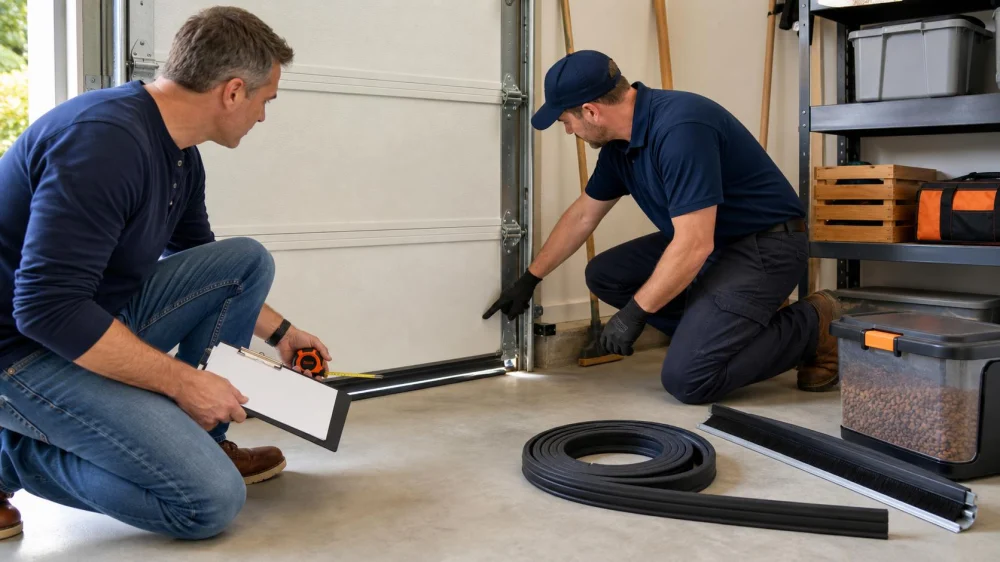
To pest-proof a garage door, inspect the closed door in daylight, photograph gaps, and check the bottom seal, side and top weatherstripping, threshold, corners, track area, and adjacent wall penetrations. Replace damaged seals, repair the door’s alignment, seal suitable building gaps, and store food securely. Never adjust high-tension springs or block required drainage, ventilation, or door movement.
Do It Yourself Pest Control Store
GreenvilleGreenville CountySouth Carolina
2430 E North St, Greenville, SC 29615, USA
Inspect before buying materials
Start with the door closed and the opener disconnected only if the manufacturer’s safe inspection procedure calls for it. Look from inside during daylight without staring at a bright sunbeam. Visible light can reveal gaps, but absence of light does not prove a pest-tight seal.
Walk the full perimeter and record:
- Torn, flattened, brittle, or missing bottom rubber.
- Daylight at the bottom corners or between panels.
- Uneven contact with a sloped or cracked floor.
- Loose side and top weatherstripping.
- Gnaw marks, droppings, grease rubs, insect remains, or nesting.
- Gaps around cables, pipes, vents, and the shared house wall.
- Water tracks that show where sealing could trap moisture.
Map the common entry gaps
| Location | Likely cause | Best next check |
|---|---|---|
| Bottom center | Worn seal or uneven slab | Seal profile and floor level |
| Bottom corners | Seal shrinkage, track gap, or trim wear | Door alignment and corner geometry |
| Sides or top | Damaged weatherstrip or bowed trim | Continuous contact when closed |
| Between panels | Panel seal damage or door distortion | Manufacturer-approved panel service |
| Wall penetrations | Unsealed utility openings | Pipe, cable, vent, and code requirements |
| Shared interior door | Weak sweep or frame seal | Fire-rating and local building rules |
Match each gap to a repair
Use components designed for the exact door model and gap. A replacement bottom seal must fit its retainer profile and allow the door to close without excessive opener force. Side and top weatherstripping should lightly contact the face of the closed door without folding into tracks.
A threshold can help on some uneven slabs, but it must not create a trip hazard, interfere with safety reversal, or redirect rain into the garage. Caulk is appropriate for stationary joints, not moving tracks, rollers, drainage gaps, or unknown ventilation openings. For larger holes, use durable pest-resistant building materials rather than foam alone where gnawing is likely.
If the door is crooked, binds, reverses unexpectedly, or leaves an uneven gap, arrange professional door service before adding seals. Covering a mechanical fault can strain the opener and create a safety hazard.

Remove food, water, and shelter
Exclusion works better when the garage offers fewer resources. Store bird seed, grass seed, pet food, and pantry overflow in sturdy containers with tight lids. Clean spills, empty pet bowls overnight, secure trash, and move cardboard and fabric off the floor.
Repair plumbing drips and address rain entry. Reduce dense clutter along walls so droppings, webbing, gnawing, and insect activity are visible during inspection. Trim vegetation that touches the structure and keep firewood away from the garage wall where practical.
Monitor after sealing
Inspect again after one week and after major weather changes. Confirm the door closes smoothly, the opener reverses according to the manufacturer’s test, water drains correctly, and new pest signs have not appeared elsewhere.
Place non-toxic monitors or traps only where children and pets cannot reach them and where they will not interfere with vehicles. Match any control product to the identified pest. If using a pesticide, follow the complete EPA-registered label; never apply a general spray across the door, floor, or stored items just in case.
Garage pest-proofing checklist
- Inspect the closed door’s bottom, corners, sides, and top.
- Photograph gaps and measure without placing fingers near pinch points.
- Identify the door and seal profile before buying parts.
- Replace worn seals and weatherstrip with compatible components.
- Have misalignment, springs, cables, and tracks serviced professionally.
- Seal suitable stationary wall penetrations.
- Store food and seed in tight, pest-resistant containers.
- Remove water, spills, cardboard, and hidden nesting space.
- Test safe door operation after repairs.
- Monitor for fresh signs and document recurrence.
Safety and repair limits
Garage-door springs, cables, bottom brackets, and some hardware can be under dangerous tension. Do not loosen, cut, or adjust them unless you are trained and the manufacturer specifically authorizes the procedure. Keep hands away from tracks, rollers, hinges, and panel joints.
Do not compromise fire-rated assemblies, combustion-air openings, dryer or appliance vents, drainage, or electrical clearances. A contractor can verify building requirements. For active bats, stinging insects, snakes, widespread rodents, or contamination, use the appropriate wildlife, pest-control, or public-health professional.
Evidence behind this guide
The U.S. Environmental Protection Agency recommends integrated pest management, including prevention and nonchemical controls before narrowly targeted pesticide use. Its housing guidance specifically recommends weatherproof door sweeps and reducing bottom gaps. CDC rodent-prevention material likewise emphasizes sealing holes and securing food. See EPA housing pest-control resources, the EPA Citizen’s Guide, and CDC rodent prevention guidance.
Frequently asked questions
Should a garage door seal be airtight?
No. The goal is continuous appropriate contact without blocking required ventilation, drainage, or movement. Codes and appliance needs vary.
Can expanding foam seal every pest gap?
No. Foam may be unsuitable for moving parts, fire-rated penetrations, wet areas, or gnaw-prone openings. Match the material to the joint and building requirement.
Why is there still a corner gap after replacing the seal?
The slab, track, trim, retainer, or door alignment may be uneven. Have the geometry assessed rather than stacking materials that interfere with closure.
Should I spray pesticide along the whole threshold?
Not automatically. Identify the pest and use exclusion, sanitation, and monitoring first. If a pesticide is needed, use only a product labeled for that pest, site, and application.
Next steps
Photograph the closed door in daylight, map every gap and pest sign, and identify the exact seal system. Remove food and clutter, replace compatible weatherstripping, and schedule professional adjustment for mechanical faults. Recheck closure, safety reversal, drainage, and pest activity after the repair.


 Cox Termite & Pest, LLC.5.0 (4 reviews)
 Emerald Tree & Shrub Care Company4.0 (11 reviews)
 Carolina Honeybee Removal4.0 (36 reviews)
 Aptive Pest Control4.0 (3442 reviews)
 Dodson Pest Control4.0 (349 reviews)
 Terminix3.0 (202 reviews)
 How to Block Pest Entry at Door Thresholds Effectively
 How to Seal Cracks in Concrete to Block Insects
 How to Use Barrier Sprays Strategically for Effective Pest Control
 How to Deal With Pest Issues Near Pools – Effective Control Tips
 How to Keep Your Home Pest-Free After Renovations
 Safe Pest Control Around Food Storage Areas